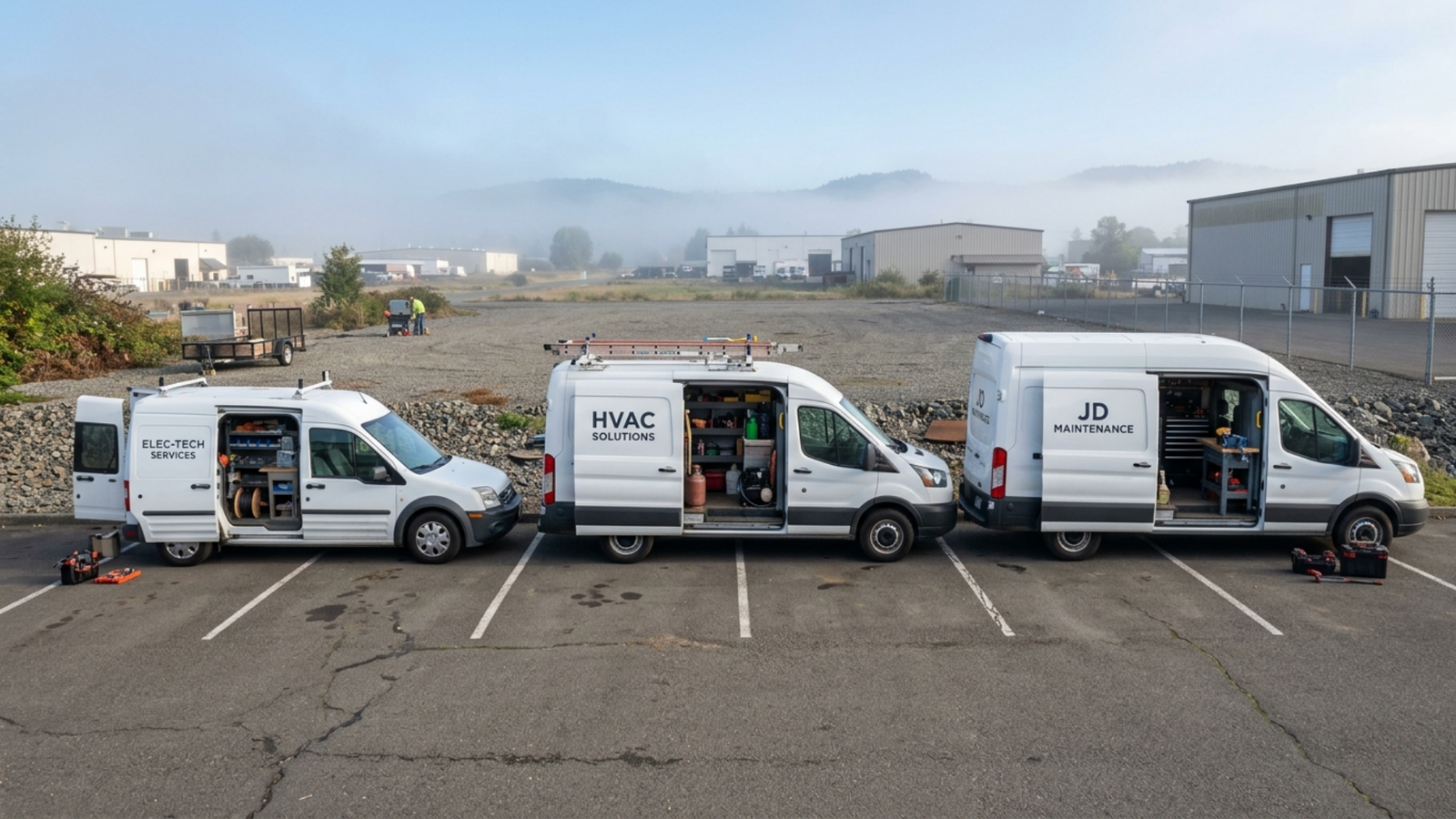
Your van is the second biggest investment in your business after yourself. Choosing badly will cost you money every day for the next 5-10 years.
There is no single perfect van. It depends on your trade, your work area, and the type of jobs you do. Let’s look at the different categories.
Small van (such as a Berlingo, Kangoo or Partner)
Ideal for: Electricians who mainly carry out repairs and small installations in homes. Locksmiths. Appliance service technicians.
Advantages: Fits almost anywhere, uses little fuel (5-6 l/100km), easy to park in town, cheaper to buy and maintain.
Limitations: Cannot accommodate a long ladder. Limited load space. If you grow to 2 people + materials, it will be too small.
New vehicle budget: €18,000–€24,000 + VAT.
Medium van (such as a Vito, Trafic or Transit Custom)
Ideal for: Most trades. Plumbers, air-conditioning engineers, electricians working on building projects, installation carpenters.
Advantages: Good balance between space and manoeuvrability. Holds all the materials needed for a normal working day. The long version can accommodate a ladder. Can be fitted with shelving.
Limitations: Uses more fuel (7-9 l/100km). Can be difficult to park in historic town centres. More expensive to maintain.
New vehicle budget: €28,000–€38,000 + VAT.
Large van (such as a Sprinter, Crafter or Master L3H2)
Ideal for: Companies with several technicians carrying a large amount of materials. Air-conditioning installers transporting large equipment. Builders.
Advantages: Space for everything. You can fit out a complete workshop inside. Some models allow you to stand upright inside.
Limitations: Uses a lot of fuel (10-12 l/100km). Difficult to manoeuvre. May require a special parking space. A category B licence is sufficient up to a gross vehicle weight of 3,500 kg.
New vehicle budget: €35,000–€50,000 + VAT.
Buying, leasing or contract hire?
| Purchase | Leasing | Contract hire | |
|---|---|---|---|
| Ownership | Yours | Yours at the end | Never yours |
| Initial payment | High (or finance) | Low or none | None |
| Monthly payment | Loan | Medium | High (all-inclusive) |
| Maintenance | Your responsibility | Your responsibility | Included |
| Insurance | Your responsibility | Your responsibility | Included |
| Tax advantage | Depreciation | Deductible payment | Deductible payment |
| Ideal for | If you have cash available | If you want to own it without a large initial outlay | If you do not want to worry about it |
Diesel, petrol or electric
In 2026, electric vans are starting to become viable for urban operators with short routes (less than 150 km/day): a real-world range of 200-250 km, ‘fuel’ costs 70% lower, and unrestricted access to low-emission zones. The problems remain the price (30-40% higher) and charging on the road for long routes.
For 80% of professionals in the sector, a diesel van remains the most practical option today. But if you work in an urban area and follow predictable routes, it is worth doing the sums for an electric one.
Three final tips
- Do not buy with only today in mind. Think about what your business will look like in 3 years. It is better to have something larger than you need now than to outgrow it in 18 months.
- Try before you buy. Drive it for a full day. Park in the streets where you work. Load all your materials and check that everything fits.
- Interior fittings are not optional. Budget for shelving and interior organisation together with the van. Do not treat it as something you will ‘get round to later’. It is part of the investment.