If you are self-employed or run a small technical services company, there are dates and obligations you cannot overlook. This guide summarises them without jargon.
I am not a tax adviser — that is what your accountant is for. But after speaking to hundreds of professionals in the sector, these are the topics that cause the most confusion.
The quarterly obligations you cannot forget
Every quarter you must submit:
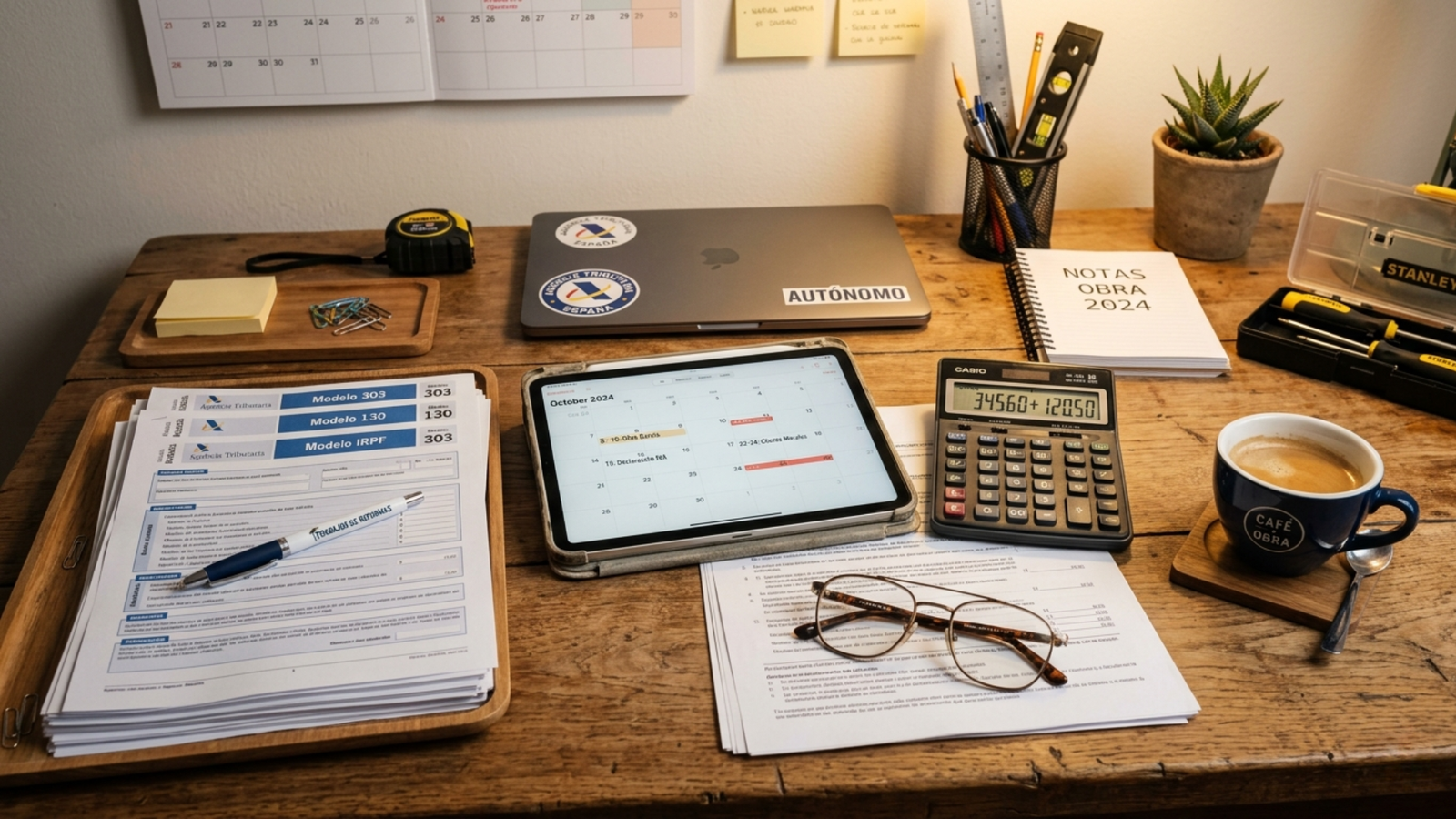
- Form 303 (VAT). You declare the VAT you have charged your customers minus the VAT you have paid. The difference is paid to the Spanish Tax Agency. Deadlines: 20 April, 20 July, 20 October and 30 January.
- Form 130 (personal income tax). This is an instalment payment towards your personal income tax. You essentially pay 20% of your quarterly profits in advance. The deadlines are the same as for Form 303.
If you have employees, you must also submit:
- Form 111. Personal income tax withholding from payroll.
- Social security contributions. Monthly contributions for each employee.
The self-employed contribution in 2026
Since 2023, self-employed social security contributions have been calculated using actual income bands. In 2026, contributions range from around €230/month for low net earnings to more than €500/month for high earnings. Check the updated table on the Social Security website or ask your accountant.
Key advice: many technicians pay a higher contribution than they should because they have not updated their income band. Check yours.
Tax-deductible expenses you are not taking advantage of
- The van. If you use it exclusively for work, you can deduct 100% of the leasing costs, insurance, fuel, repairs and tolls. If it is for mixed use, 50%.
- Tools and equipment. Everything you buy for work is tax-deductible. Keep the invoices.
- Mobile phone. If you have a line exclusively for work, 100%. If it is for mixed use, 50%.
- Workwear. PPE, boots and branded uniforms. Tax-deductible.
- Training. Courses, certifications and licences. All tax-deductible if related to your business activity.
- Software and apps. Management software, invoicing software and so on. 100% tax-deductible.
- Meals and travel. If you eat away from home for work, up to €26.67/day if you do not stay overnight and €53.34/day if you do. You must pay by card and the invoice must be in your name.
- Professional insurance premiums and professional body and association fees. Tax-deductible.
The most costly mistake: mixing personal and business accounts
Open a separate bank account for the business. It does not have to be a ‘business account’ — a normal current account will do. But make sure all the business's money goes through it. This simplifies accounting, reduces errors and, if you are ever audited, makes everything transparent.
Self-employed or limited company?
General rule: if your net annual turnover is less than €40,000–€50,000, remain self-employed. If your turnover is higher, a limited company begins to offer tax advantages (you pay tax at a flat rate of 25% instead of the progressive personal income tax bands). But a limited company involves more bureaucracy and management costs. Discuss it with your adviser when you reach that range.
Three habits that will save you trouble
- Save all invoices digitally on the same day. Take a photo with your mobile and save it. If you lose the paper copy, you lose the deduction.
- Set aside 25-30% of every payment. That money is for tax. Do not touch it. Many self-employed people spend everything and then face a nasty shock at the end of the quarter.
- Meet with your accountant at least once a quarter. Not just to submit forms — discuss how the business is doing and what you can optimise.